Peel-and-Stick Wallpaper in Denver — Does It Actually Work?
Peel-and-Stick Wallpaper in Denver — The Honest Assessment
Peel-and-stick wallpaper looks like an easy answer: no paste, no mess, removable if you change your mind. But Denver’s unique climate creates specific challenges for pressure-sensitive adhesives. Here is an honest, experienced assessment.
Peel-and-stick wallpaper works adequately in Denver on smooth, primed drywall in low-traffic areas with consistent temperature — but Denver’s low humidity (14–17 percent) accelerates adhesive degradation at edges and corners, often causing lifting within 1–3 years. It is best for renters, nurseries, and temporary use. For permanent installations, traditional paste-applied wallpaper professionally installed will outlast peel-and-stick by a decade or more in Colorado’s climate.
How Peel-and-Stick Wallpaper Works
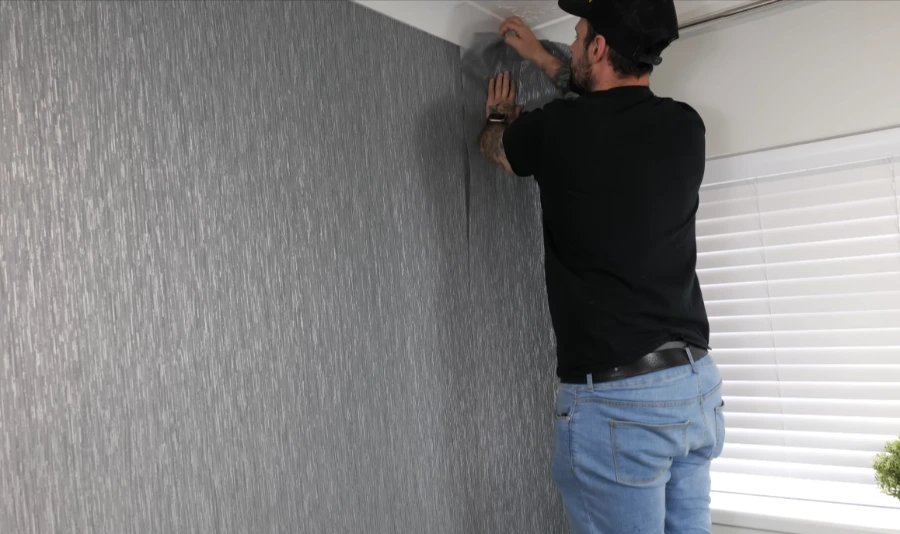
Peel-and-stick wallpaper uses a pressure-sensitive adhesive (PSA) applied to the back of the paper. You peel the backing and press the strip to the wall — no paste, no water activation, just pressure. The same technology is used in vinyl floor tiles, contact paper, and removable decals. The quality of peel-and-stick wallpaper has improved dramatically in recent years. Better PSA formulations, thicker paper substrates, and improved print technologies have made it a genuinely usable product for appropriate applications. However, it is fundamentally still a temporary adhesive system, not a permanent installation.
Denver’s Humidity Challenge for Peel-and-Stick
Pressure-sensitive adhesives are humidity-sensitive. In moderate humidity environments (40–60 percent RH), PSAs maintain good bond strength and flexibility over time. In Denver’s very low humidity (14–17 percent average, dropping lower in winter), the adhesive can dry out and become brittle faster than in typical climates. This accelerates edge lifting and corner peeling — the most common peel-and-stick failure modes. The problem is worse near HVAC vents, in rooms with forced-air heat running frequently in winter, and in west-facing rooms that experience Denver’s intense afternoon sun heating the wall surface.
Where Peel-and-Stick Performs Well in Denver
In the right conditions, peel-and-stick works acceptably in Denver. It performs best in interior rooms without HVAC vent proximity, on smooth primed drywall (not painted texture), in rooms with fairly stable temperatures, and in applications where it will be seen but not touched frequently. Nurseries where you expect to change the design in 2–3 years anyway are a good fit. Rental apartments where permanent modifications are not allowed benefit from peel-and-stick. Basement accent walls with lower temperature swings also perform reasonably well — expect 2–4 years of good performance before edges start lifting.
Where Peel-and-Stick Fails in Denver
Peel-and-stick consistently underperforms in Denver on textured walls — the PSA cannot bond fully to peaks and valleys of orange-peel or knockdown texture, and the paper lifts quickly. It fails faster near heating and cooling vents where temperature and humidity fluctuate dramatically. It struggles in rooms receiving direct Denver sunlight for more than 4 hours per day, where the wall surface heats and the adhesive softens then re-cools repeatedly. It also struggles at seams where paper-to-paper junction cannot be bonded. Do not use peel-and-stick in bathrooms or kitchens where humidity fluctuates.
The Professional Advantage with Traditional Wallpaper
Traditional paste wallpaper, professionally installed, creates a fundamentally different bond. Commercial wallpaper adhesive is formulated for the specific paper substrate being used, applied to properly primed walls, and cures into an extremely stable film. Seams are wet-bonded during installation and feathered to minimize visibility. The result in Denver’s dry climate is exceptional longevity — 10–15 years is typical for quality traditional installation. Professionally installed wallpaper also looks better: pattern alignment is precise, seams are tight, and there is no edge lifting to deal with.
Making the Right Choice for Your Denver Home
Choose peel-and-stick when: you rent and cannot make permanent modifications, you expect to change the design in 2–3 years, it is a low-traffic accent wall in a stable room, or budget constraints make it the only option. Choose traditional professionally installed wallpaper when: you own your home, you want a result that lasts 10+ years, the paper is premium or grasscloth, the wall has any texture, or the room experiences humidity or temperature fluctuations. The cost difference in a small room like a powder room is often only $200–$400 — a modest premium for a result that lasts three to five times longer.
Get a Free Wallpaper Estimate in Denver
Wondering whether peel-and-stick or traditional wallpaper is right for your Denver project? Our team gives honest recommendations based on your walls, room conditions, and timeline. Get a free estimate and let us help you make the right choice.
Not sure peel-and-stick is right for your Denver home? Read our in-depth guide to peel-and-stick wallpaper in Denver’s climate, or contact us about traditional wallpaper installation for a longer-lasting result. Get a free quote.